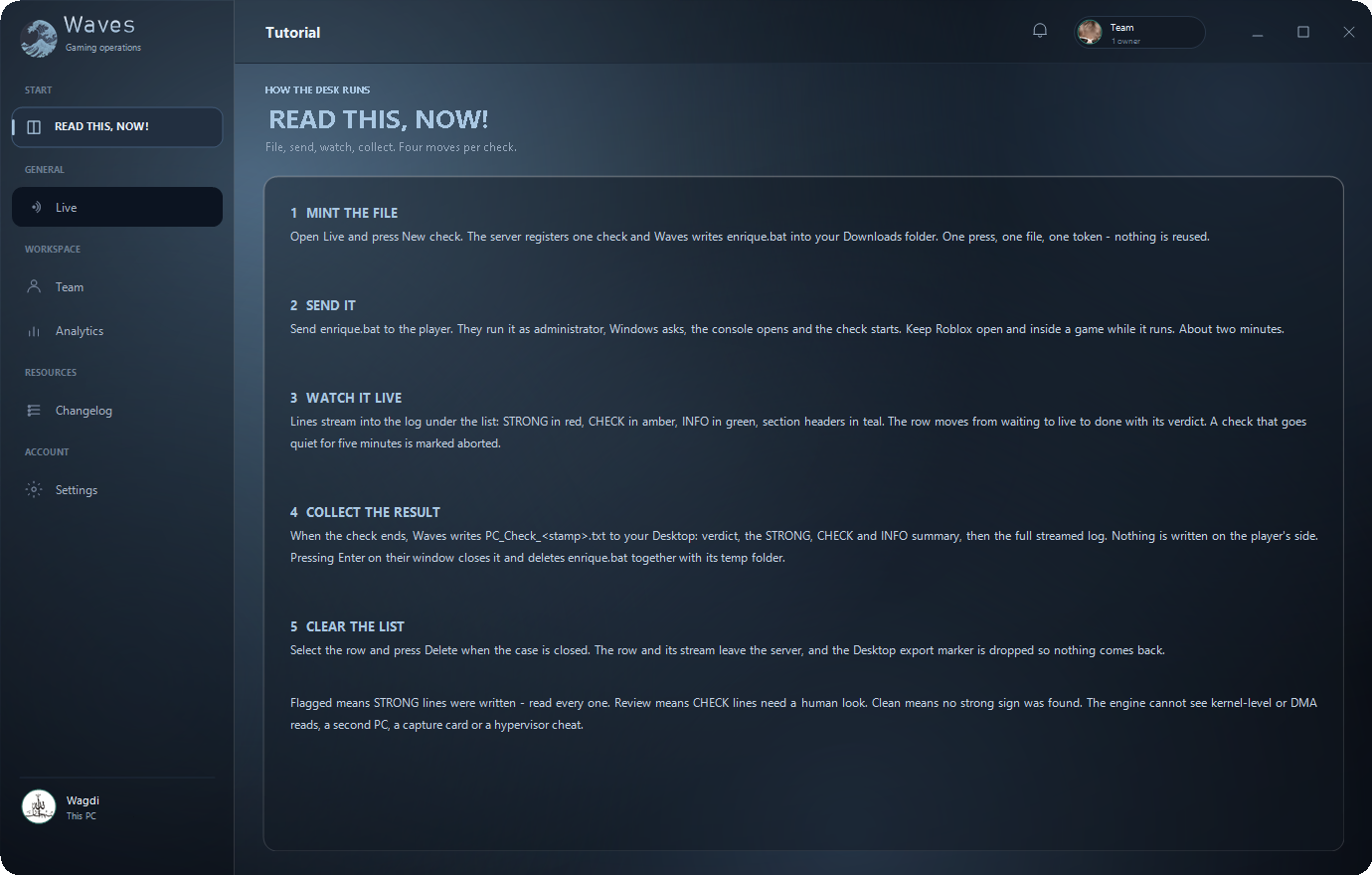
Mint the check
Staff press one button. The server registers a single check and writes enrique.bat with its own token baked in. One check, one file, one token — nothing is reused.
Windows · read-only · hash-verified
Waves inspects a machine for about two minutes, streams every finding to the checker live, and writes a report you can audit line by line. Nothing is installed. Nothing is changed. The file deletes itself when it's done.
STRONGManually mapped module in RobloxPlayerBeta.exe
STRONGUnsigned driver loaded from a user folder
CHECKUnsigned module outside the game folder
INFOHandle to the client held with read-memory rights
How it works
Staff press one button. The server registers a single check and writes enrique.bat with its own token baked in. One check, one file, one token — nothing is reused.
The player runs it as administrator. Windows asks them to confirm. They keep the game open and in a match, because half of what the check looks at only exists while the client is running.
Lines stream to the checker as they're produced — strong findings, soft signals, section by section. You're watching the run, not waiting for a file to come back hours later.
The run ends with a verdict, a correlation block, and a full report on the checker's side. The player's copy removes itself and its temp folder.
Coverage
Not a scan of file names. It reads the artefacts Windows leaves behind, the memory of running processes, and the client itself.
Injected modules, manually mapped code, threads starting outside any loaded module, private executable regions, hollowed hosts.
Who else has a handle to the client process, and with which rights — read memory, write memory, create thread, duplicate handle.
Signatures, install history, driver objects with no service behind them, code-integrity blocks, test-signing state.
PCI and USB history, FPGA and serial-bridge devices that have ever been plugged in, Secure Boot and IOMMU state.
BAM, UserAssist, Prefetch (parsed, not just listed), USN journal, Amcache, SRUM, ShimCache — with timestamps.
The raw MFT, so files that were deleted but are still named in the table come back into view.
Binary signature, loaded modules, overlays drawn over it, launch arguments, client settings files.
Cleared logs, a recreated USN journal, cleaned Prefetch, wiped history, edited hosts, suspicious certificates.
Plans
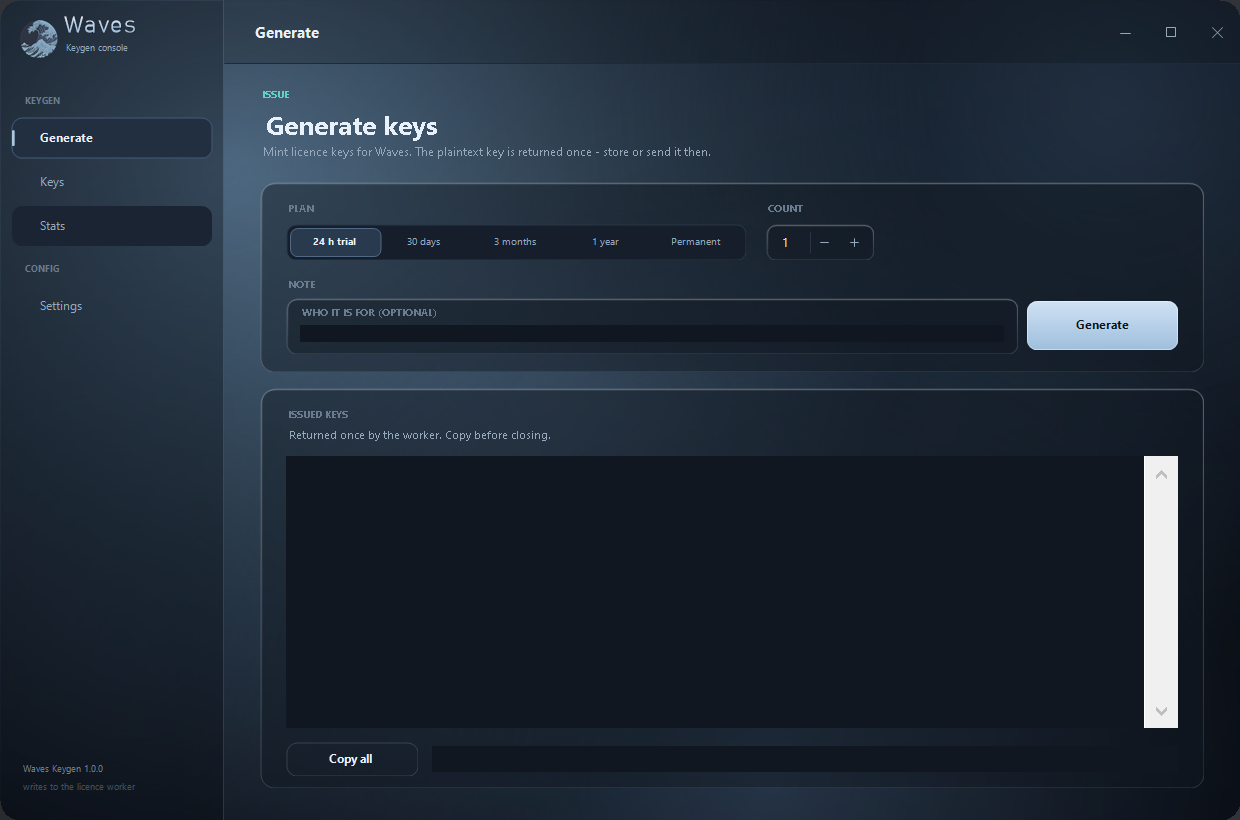
Every plan runs the same engine. The only difference is how long the key stays valid. Prices in USD, one key per machine.
$3.50
$10
$25
$100
$150
Keys are locked to the machine on first activation and can't be transferred. The clock starts on activation, not on purchase.
Verification
Every build ships with a SHA-256. Match the hash and you have exactly what we published — not a repack.
26fad4181e2a531011c341566fbadcad0c7108f76316d2589341bcdd8b5ad7fb
f1e3de3147748af973d7857c5e3fd1d113ea570e64d19367b91dd22e6381a884
Some engines flag these files. That's expected: elevated batch, PowerShell, network calls and self-deletion are exactly the shapes a scanner is trained to distrust. The FAQ explains it line by line.
Inside
Questions
No. It's a batch file and a signed-nothing console, and both are published with hashes you can check. It installs nothing, starts no services, and deletes itself when it finishes. Some engines will still flag it — see the next question.
Because of what it does, not why. It requests administrator rights, runs PowerShell, reads system information, opens a network connection and deletes itself. Every one of those is normal here and every one is on a malware heuristic list. A tool that inspects a PC looks a lot like the thing it's looking for.
No. It reads. Nothing is written to the game, nothing is patched, nothing is uploaded from your machine except the short text findings it prints. It's not a background anti-cheat and it doesn't run while you play.
No, and anyone who says otherwise is selling something. It's user-mode: a DMA card with cloned IDs, a second PC, a capture card, or a hypervisor that cleaned up after itself leaves nothing for it to read. It catches what leaves traces on the machine — which is most of what people actually use.
It says so in the report. Missing data is reported as missing, never guessed at. That's why the verdict is a starting point and not a sentence.
As soon as payment is confirmed. Open a ticket on Discord with the plan you want; payment methods are listed there.
Join the Discord, open a ticket, pick a plan. The check takes two minutes and the report is yours.
Join Discord